This is default featured slide 1 title

Go to Blogger edit html and find these sentences.Now replace these sentences with your own descriptions.

This is default featured slide 2 title

Go to Blogger edit html and find these sentences.Now replace these sentences with your own descriptions.

This is default featured slide 3 title

Go to Blogger edit html and find these sentences.Now replace these sentences with your own descriptions.

This is default featured slide 4 title

Go to Blogger edit html and find these sentences.Now replace these sentences with your own descriptions.

This is default featured slide 5 title

Go to Blogger edit html and find these sentences.Now replace these sentences with your own descriptions.

Sunday, 10 March 2013

Trends in the internet and WWW

The internet is a global system of interconnected computer networks that use the standard Internet Protocol Suite (TCP/IP) to serve billions of users worldwide. It's a network of networks that consists of millions of private, public, academic, business and government networks of local to global scope that are linked by a board array of electronic, wireless and optical networking technologies. The internet carries an extensive range of information resources and services such as the inter-linked hypertext documents of the World Wide Web (WWW) and the infrastructure to support email.


Database Management

A database management system is a set of software programs that allows users to create, edit and update data in database files, store and retrieve data from those database files. Data in a database can be added, deleted, changed, sorted or searched all using a DBMS. For example: If you were an employee in a large organization, the information about you would likely be stored in different files that are linked together. One file about you would pertain to your skills and abilities, another file to your income text status, another to your home, office address, telephone number and another to your annual performance ratings. By cross-referencing these files, someone could change a person's address in one file and it would automatically be reflected in all the other files.  


DBMS are commonly used to manage:
  • Membership and subscription mailing lists
  • Accounting and book keeping information 
  • The data obtained from scientific research
  • Customer information
  • Inventory information
  • Personal records
  • Library information


Information System

Nowadays, society become dependent on information systems. Information systems has help people in their daily life routine. Information system itself bring the meaning of business application in the computer that manage their operations, compete in the market place, accounts and manage human resources.

An information system can be defined technically as a set of interrelated components that collect or retrieve, process, store, and distribute information to support decision making and control in an organization. In addition to supporting decision making, coordination, and control, information systems may also help managers and workers analyze problems, visualize complex subjects, and create new products.
Three activities in an information system produce the information that organizations need to make decisions, control operations, analyze problems, and create new products or services. These activities are input, processing, and output. Input captures or collects raw data from within the organization or from its external environment. Processing converts this raw input into a more meaningful form. Output transfers the processed information to the people who will use it or to the activities for which it will be used. Information systems also require feedback, which is output that is returned to appropriate members of the organization to help them evaluate or correct the input stage.


                               Functions of an Information System

Friday, 8 March 2013

Information Technology (IT) & Information and Communication Technology (ICT)

Information Technology and is pronounced (IT). It refers to anything related to computing technology, such as networking, hardware, software, the Internet or the people that work with this technologies. IT departments for managing the computers, networks and other technical areas of their businesses. Actually, IT include computer programming, network administration, computer engineering, web development, technical support and many other related occupations. Since we live in the 'information age', Information Technology has become a part of our everyday lives.


Information and Communication Technology, it's refer to technologies that provide access to information through telecommunications. It's similar to Information Technology (IT), but focuses primarily on communication technologies. This include the Internet, wireless networks, cell phones and other communication mediums.For example: Modern information and communication technology have created a "Global Village" in which people can communicate with others across the world as if they were living next door. For this reason, ICT is often studied in the context of how modern communication technology affect society.


ICT IN BANKING (KENIYA)

Data, Information & Information Management


Data is raw material for data processing, data relates to fact, event and transactions. Data refers to unprocessed information.

Information is data that has been processed in such a way as to be meaningful to the person who receives it. It's anything that is communicated.

For example, researchers who conduct market research survey might ask a number of the public to complete questionnaires about a product or a service. These completed questionnaires are data, they are processed and analyze in order to prepare a report on the survey. This resulting report is information.


Information Management (IM) is the collection and management of information from one or more sources and the distribution of that information to one or more audiences. This sometimes involves those who have a stake in or a right to that information. Management means the organization of and control over the structure, processing and delivery of information. 


Thursday, 13 December 2012

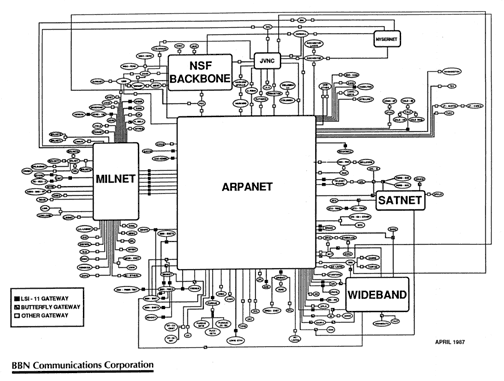
Ninth week learnt about History of the Internet

When the original conceptual foundation of the Internet was laid back in the 50s, no one had the slightest idea of how far this project would go. At those insecure post-war times of alienation and deepening political division, the vision of the Internet as we see it today, was only a matter of science fiction dreaming. Starting as a military project in the United States, it quickly became very popular in several other countries. Now, several decades later, with the spread of the democratic lifestyle and the amazing technological progress, we all witness the existence of a parallel world of unlimited communication possibilities that occupies an increasing part of our daily routine with the sole purpose of facilitating our lives.


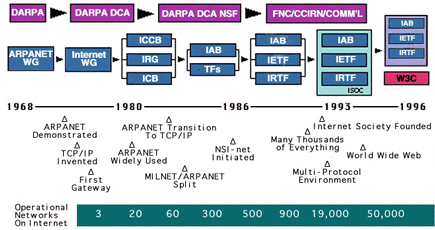
History of the Internet:


 Mid 1960:   Papers on “Packet Switching” emerge.

 End 1969s:   ARPA sponsors the development of a packet-switching network, called the
 ARPANET. First four nodes are UCLA, SRI, U. Utah, UCSB.

  1974:   The TCP/IP protocols and model are being proposed by Cerf/Kahn. 

  1980:   IPv4 is introduced.


  1983:   ARPANET adopts TCP/IP. At this time, the ARPANET has 200 routers. 

  1984:   NSF funds a TCP/IP based backbone network. This   backbone grows into the NSFNET,
which becomes the successor of the ARPANET.

 1995:   NSF stops funding of NSFNET. The Internet is completely commercial. 

Time line of the Internet:


Then we discussed about web page, browser and web engine.


Eighth week learnt about Microsoft Powerpoint


In week 8, Our lecturer showed us how to create one new slide and Insert any text, how to make slide more attractive, use the themes or background, use the custom animation to add effects on any text, to insert and work with pictures, to insert clip art, screenshots in slides.


Inserting a screen clipping from a window and Transition:
 
Task and working with video:  
Working with Video include the following task: Inserting video, Preview and re-size the video, Edit and format,
Formatting the
appearance of the video. Inserting video
and edit and format the video.


Our lecturer told us to prepared power point slides presentation is about social networking.
                                
                                   Table of Contact


Topic
Introduction
Advantages 
Disadvantages
Conclusion
 
We have to submit this power point  presentation Week Eleven and I think it will be interesting for us.